

Back to Blog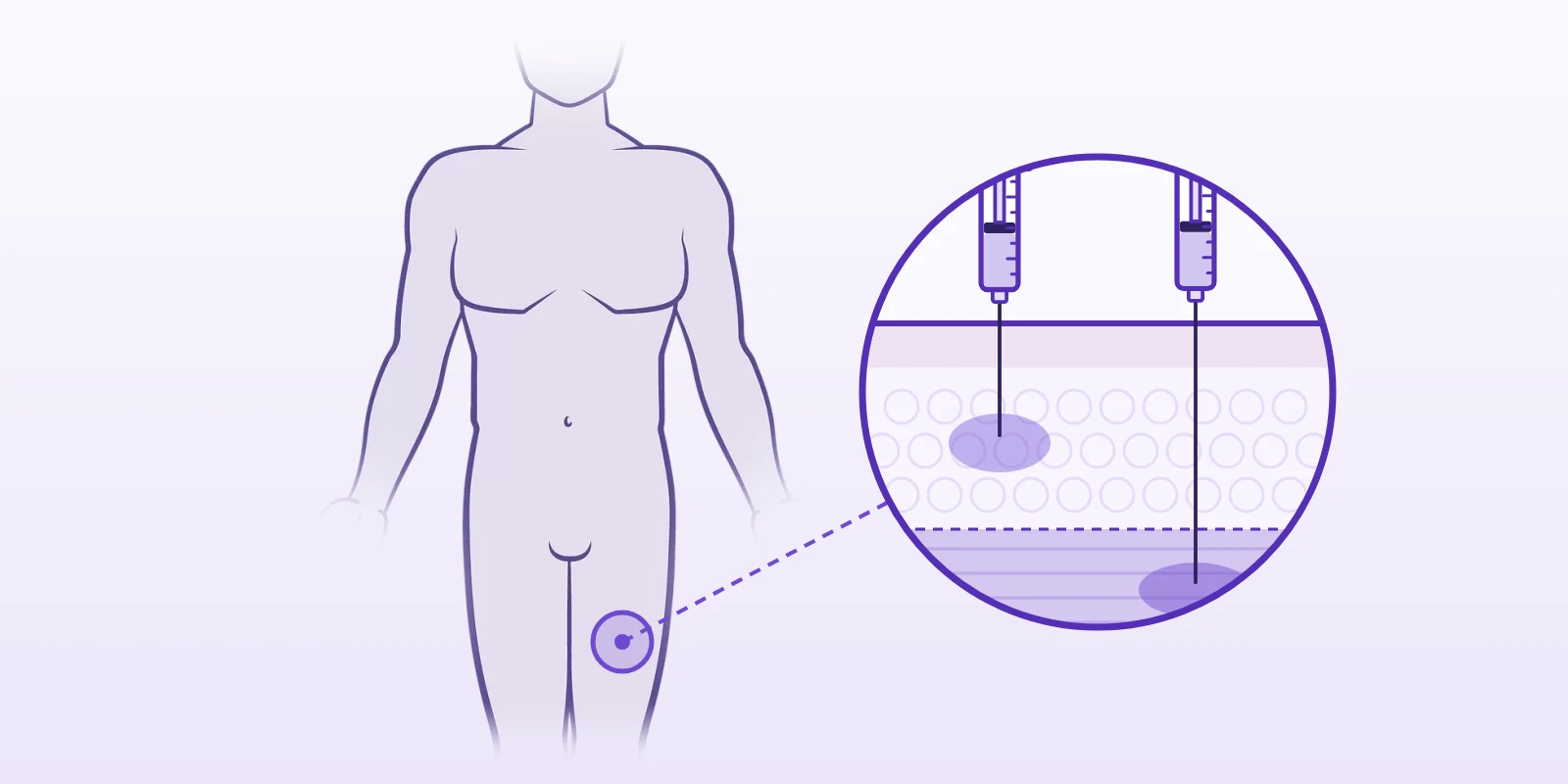
Subcutaneous vs Intramuscular Injection: What's the Difference?
November 24, 2026
6 min read
Monica Hodgson
injection-sites
subcutaneous
intramuscular
SubQ shots go into fat, IM shots go into muscle. Here's how they differ in depth, sites, needles, angle and absorption, and why you should never swap one for the other on your own.
If your instructions say "subcutaneous" and a friend's say "intramuscular," you might wonder how different they really are. Aren't they both just shots?
They're both injections, but they go to different layers of your body, use different sites and often different needles, and the medication is absorbed differently.
A subcutaneous (subQ) injection goes into the layer of fat just under your skin. An intramuscular (IM) injection goes deeper, into a muscle. Each medication is designed for one route or the other, so the right one for you is whichever your prescription and medication leaflet say.
Here's how the two compare.
The Layers Under Your Skin
Picture three layers stacked on top of each other:
A subQ injection stops in the middle layer. An IM injection passes through the skin and fat and into the muscle. Everything else about the two follows from that difference in depth.
Side-by-Side Comparison
| Subcutaneous (subQ) | Intramuscular (IM) | |
|---|---|---|
| Where it goes | The fat layer under the skin | Into a muscle |
| Common sites | Stomach, outer thighs, back of upper arms | Upper arm (deltoid), outer thigh, hip and buttock |
| Needle | Usually short and thin | Usually longer, to reach the muscle |
| Angle | Usually 90 degrees, or 45 degrees with little fat | Usually 90 degrees |
| Pinch the skin? | Often, to lift fat away from muscle | Usually not. Some techniques stretch the skin flat instead |
| How fast it's absorbed | Generally slower and steadier | Generally faster, because muscle has a richer blood supply |
| Who usually gives it at home | Very commonly self-injected | Self-injected less often, and some sites are hard to reach alone |
Why the Depth Matters
Fat has fewer blood vessels than muscle. That's why medication injected under the skin is generally absorbed more slowly and evenly, and why muscle is often used when a medication needs to reach the bloodstream faster or when a larger amount needs to be given.
This is also why the route isn't interchangeable. A medication designed to be absorbed slowly from fat may behave differently if it lands in muscle, and the reverse is true too. The route is part of how the medication is meant to work.
Sites for Each
SubQ sites are places with a reasonable layer of fat: the stomach (staying at least 2 inches from the belly button), the outer upper thighs and the back of the upper arms. Our guide to subcutaneous injection sites shows each one.
IM sites are large muscles: the deltoid at the top of the arm, the outer thigh muscle and the muscles of the hip and buttock. Some of these are best done with help or after hands-on teaching. Our guide to intramuscular injection sites covers where they are.
Whichever route you use, rotate between spots so no single area gets overused. The free injection site rotation tool lets you plan a rotation for either.
Optimize Your Peptide Therapy Journey
Take control of your peptide therapy with PeptideKit - the comprehensive app designed to help you track, monitor, and optimize your treatment:
- Add peptide therapy protocols with custom schedules that work for you
- Easy dose logging with customizable reminder notifications
- Body change tracking to monitor your transformation
- Progress visualization with charts and trend analysis
Download PeptideKit App
Scan with your iPhone camera
to download PeptideKit
Needles and Technique
SubQ injections usually use short, thin needles. Many people are taught to pinch up a fold of skin and fat first, which lifts the fat away from the muscle so the medication doesn't go too deep. Our guide to pinching the skin explains when that matters most.
IM injections usually use longer needles so they can pass through the fat and reach the muscle. The needle normally goes straight in at 90 degrees. The right length depends on the site and on how much fat you have there, which is why it's usually chosen for you.
Our guide to injection sites and needle sizes explains how needle length and site fit together.
What Happens If a SubQ Shot Goes Into Muscle?
It's possible, especially with a longer needle at a lean site or if you don't pinch when you've been told to. It can be more painful, and it may change how the medication is absorbed.
If you think it happened, don't take another shot to make up for it. Write it down and ask your pharmacist or provider whether anything needs to be done. Next time, check your technique and site with them.
The opposite can happen too. An IM injection with a needle that's too short for the site may end up in fat. That's one reason needle length for IM injections is usually chosen for you.
How It Feels
People's experiences vary, but IM injections are often described as feeling deeper and leaving the muscle a little sore for a day or so, a bit like after some vaccines. SubQ injections are often described as a quick pinch or sting at the surface.
Either way, some soreness at the site can be normal. Our guides to soreness after an injection and why injections sting cover what helps.
Keeping Track of Your Sites
Whether you inject subQ or IM, the same habits help: choose a different spot each time, write down where you went and look back before choosing the next one. PeptideKit lets you tap the exact spot on a body map when you log each shot, so you can see where the last few went before choosing the next one.
Frequently Asked Questions
What is the difference between subcutaneous and intramuscular injections?
A subcutaneous injection goes into the fat layer just under the skin. An intramuscular injection goes deeper, into a muscle. They usually use different sites and needle lengths, and the medication is absorbed at different speeds.
Which is absorbed faster, subQ or IM?
IM injections are generally absorbed faster, because muscle has a richer blood supply than fat. Exact timing depends on the medication.
Can I inject a subQ medication into muscle instead?
No, not unless your prescriber tells you to. Medications are designed for a specific route, and switching can change how they work.
Do intramuscular injections hurt more than subcutaneous?
Many people find IM injections feel deeper and leave the muscle sore for a day or so. Experiences vary, and technique makes a big difference to both.
Do you pinch the skin for an intramuscular injection?
Usually not. Pinching is mainly a subQ technique to lift fat away from muscle. IM techniques often stretch the skin flat instead. Follow what you were taught.
The Bottom Line
The difference comes down to depth. SubQ injections go into the fat under the skin, use shorter needles and are absorbed more slowly. IM injections go into muscle, use longer needles and are generally absorbed faster.
Your medication is made for one route, and that's the one to use. If you're ever unsure which one your instructions mean, ask your pharmacist before your next shot.
Always consult with qualified healthcare professionals before starting any peptide therapy protocol. This information is for educational purposes only and does not constitute medical advice.
Related Articles
Do You Pinch the Skin for a Subcutaneous Injection?
Why many people are taught to pinch the skin for a subQ injection, how to do it gently, when a pinch may not be needed, what angle goes with it, and when to let go.
IM Injection Sites: Where Intramuscular Shots Go (With Diagram)
The main intramuscular (IM) injection sites with a labeled diagram: deltoid, ventrogluteal, vastus lateralis and dorsogluteal. How each one is found, which are safest, and how IM differs from subQ.