
Back to Blog
IM Injection Sites: Where Intramuscular Shots Go (With Diagram)
November 12, 2026
11 min read
Monica Hodgson
injection-sites
peptide-therapy
intramuscular
The main intramuscular (IM) injection sites with a labeled diagram: deltoid, ventrogluteal, vastus lateralis and dorsogluteal. How each one is found, which are safest, and how IM differs from subQ.
Most people who track peptides inject subcutaneously, into the fat just under the skin. But some medications are prescribed as intramuscular (IM) injections, which go deeper, into the muscle itself. If your instructions say IM, the sites are different, the needle is different and the technique is different. Our guide to subcutaneous vs intramuscular injections compares the two side by side.
This guide covers the main sites for IM injections, with a diagram, how healthcare professionals find each one, and why some sites are safer than others. Treat it as background reading. An IM shot placed off its landmark can reach a nerve or a blood vessel, so have a nurse, pharmacist or doctor show you in person before you try one yourself.
IM Injection Sites Diagram
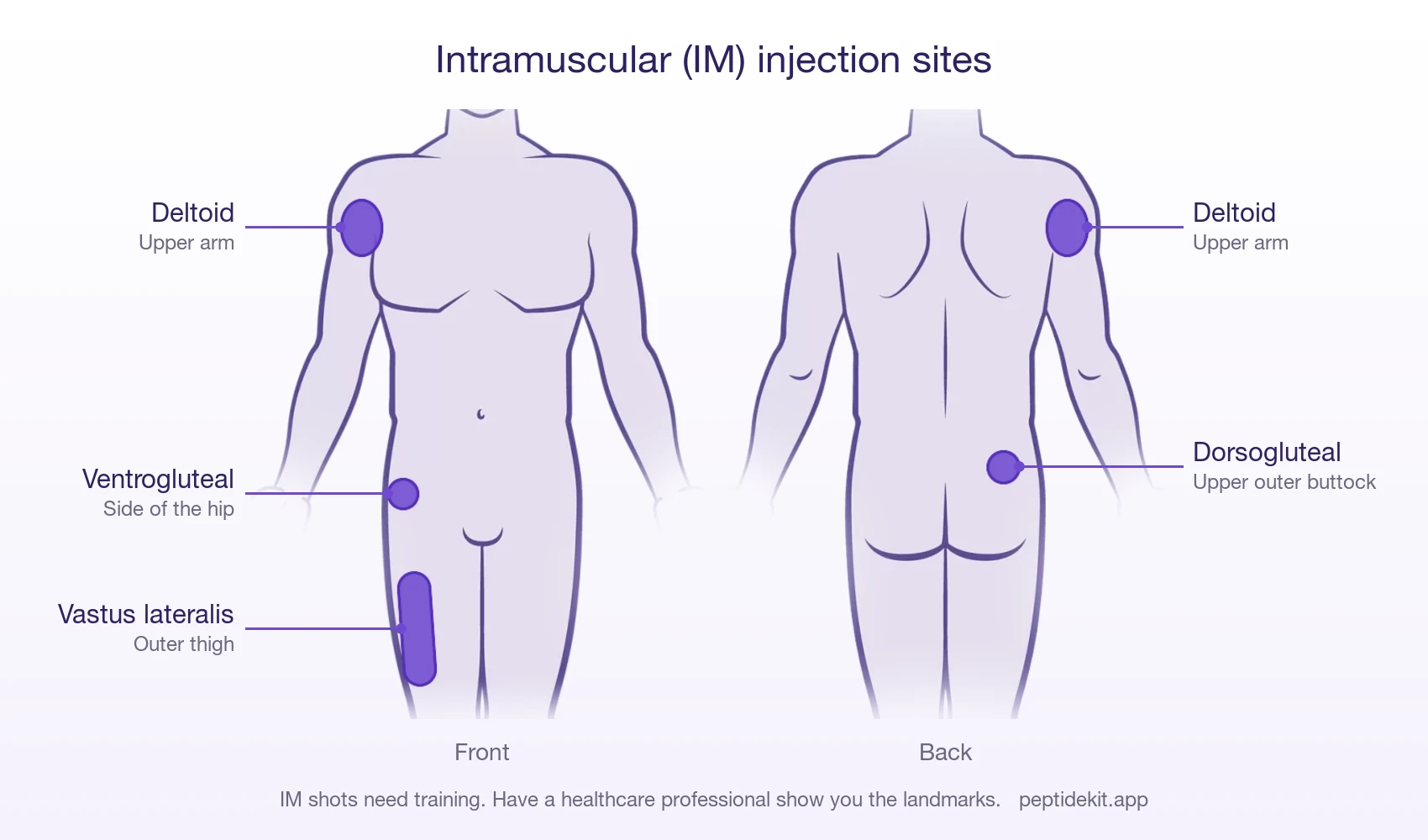
There are four standard sites for intramuscular injections in adults:
A fifth site, the rectus femoris on the front of the thigh, is sometimes used for self-injection. We'll cover it briefly too.
What Makes a Good IM Site?
A good IM site has a thick, healthy muscle. It sits well away from large nerves and blood vessels. And it has clear bony landmarks, so it can be found the same way every single time.
Those landmarks are the reason IM shots need training. With a subQ shot, being an inch off rarely matters. With an IM shot, it can.
Volume matters too. Large muscles handle larger amounts of medication more comfortably than small ones, so your prescriber will match the site to your medication and how much of it you inject.
The Deltoid Site (Upper Arm)
The deltoid is the triangle-shaped muscle that caps your shoulder. It's the IM site most people know, because it's where most vaccines go.
How it's found: feel for the acromion process, the bony ridge at the very top of your shoulder. The injection site is about two to three finger widths below it, in the thickest part of the muscle. Picture an upside-down triangle with its base along that bony ridge and its point down toward armpit level. The shot goes in the middle of the triangle.
Good to know: the deltoid is a small muscle, so it's generally used for small volumes. Going too low or too far back brings the needle closer to the radial nerve, and going too high risks the shoulder joint. That's why the triangle matters.
The Ventrogluteal Site (Side of the Hip)
Many nursing guidelines now treat the ventrogluteal site as the preferred site for adult IM injections. The gluteus medius muscle there is thick, the fat over it tends to be thinner than on the buttock, and no major nerves or blood vessels run through the area.
How it's found: this site uses a hand as the guide. To find it on the right hip, a helper places the heel of their left hand on the greater trochanter, the bony knob at the top of the thigh bone. Their index finger points to the anterior superior iliac spine, the bony point at the front of the hip. Their middle finger spreads back along the iliac crest, the top edge of the hip bone. The shot goes in the center of the V between those two fingers.
Good to know: the hand method is simple once you've learned it, but it's easy to mix up the landmarks the first few times, and it's awkward to do on yourself. This is the site where hands-on teaching matters most.
The Vastus Lateralis Site (Outer Thigh)
The vastus lateralis is the large muscle on the outer side of your thigh. It's thick, easy to see and well away from major nerves and blood vessels, which makes it a common choice for people who give themselves IM shots. It's also the usual site for babies and young children.
How it's found: divide the outer thigh into thirds, with the top of the thigh bone at one end and the knee at the other. The injection goes in the middle third, on the outer side of the leg rather than the front.
Good to know: some people find thigh shots a bit sorer afterward than hip or arm shots, especially if they work their legs hard the next day.
The Rectus Femoris Site (Front of the Thigh)
The rectus femoris runs down the front of the thigh, in the same middle third. It's easy to reach while sitting, so some people use it for self-injection. It tends to be more uncomfortable than the outer thigh, though, and it's usually a second choice rather than a first.
The Dorsogluteal Site (Upper Outer Buttock)
The dorsogluteal site, in the upper outer part of the buttock, was the standard IM site for decades. Many guidelines now recommend the ventrogluteal site instead.
The reason is what sits nearby. The sciatic nerve and the superior gluteal artery both run through the buttock, and a shot placed too low or too close to the middle can reach them. Sciatic nerve injury is one of the more serious complications of IM injections. The buttock also carries a thicker layer of fat, so a standard needle may never reach the muscle, leaving the medication in fat instead.
If you've been told to use this area, ask your provider to show you exactly where, and whether the side of the hip would work instead.
Comparing the IM Sites
| Site | Location | Muscle size | Self-injection | Main caution |
|---|---|---|---|---|
| Deltoid | Upper arm | Small | Possible but awkward | Stay inside the triangle |
| Ventrogluteal | Side of the hip | Large | Possible with practice | Landmarks take practice |
| Vastus lateralis | Outer thigh | Large | Easiest | Can be sore afterward |
| Rectus femoris | Front of the thigh | Large | Easy | Often more painful |
| Dorsogluteal | Upper outer buttock | Large | Hard | Sciatic nerve and artery nearby |
Optimize Your Peptide Therapy Journey
Take control of your peptide therapy with PeptideKit - the comprehensive app designed to help you track, monitor, and optimize your treatment:
- Add peptide therapy protocols with custom schedules that work for you
- Easy dose logging with customizable reminder notifications
- Body change tracking to monitor your transformation
- Progress visualization with charts and trend analysis
Download PeptideKit App
Scan with your iPhone camera
to download PeptideKit
IM vs SubQ Injection Sites
The two kinds of injection overlap in where they go, which causes a lot of confusion. The thigh and the buttock can host either one. What changes is depth.
| Detail | Subcutaneous (subQ) | Intramuscular (IM) |
|---|---|---|
| Where the medication goes | Fat layer under the skin | Muscle under the fat |
| Typical needle length | Short, about 4 mm to 5/8 inch | Longer, about 1 to 1.5 inches |
| Usual angle | 90 degrees, sometimes 45 | 90 degrees |
| Common sites | Abdomen, thighs, back of arms, glutes | Deltoid, side of the hip, outer thigh |
Most peptides are given subQ. If you're not sure which kind of injection your medication needs, check the label or ask your pharmacist rather than guessing. For the subQ side, see our guide to subcutaneous injection sites.
Technique Terms to Ask Your Provider About
Your provider will teach the technique that fits your medication, but a few terms come up again and again.
Z-track. The skin and fat over the site are pulled to one side before the needle goes in, then let go after it comes out. That leaves a zigzag path that helps keep the medication in the muscle and out of the tissue above. It's often used for medications that irritate tissue.
Aspiration. This means pulling back on the plunger before injecting to check for blood. CDC guidance says it isn't needed for vaccines, but practice varies for other medications and sites, so follow what your provider tells you.
Angle. IM shots go straight in, at 90 degrees, so the needle reaches the muscle by the shortest path.
Needle length. Too short and the medication ends up in fat. The right length depends on the site and on your body. Our guide to injection sites and needle sizes covers the usual ranges.
Rotating IM Injection Sites
IM sites need rotating too. Using the same muscle over and over can leave it sore, bruised or scarred, and repeated shots in one spot can cause hard knots under the skin. Most people at least alternate sides, left hip then right hip, and some move between muscles as their provider allows.
Remembering which side you used last is the part that slips. Our free injection site rotation chart includes the shoulders, thighs and glutes, so you can set the order once and follow it. For a written record, a printable injection log or a peptide tracker spreadsheet does the job, and PeptideKit saves the site with every shot you log.
If you want the reasons behind rotation in more detail, read why you should rotate injection sites.
When to Call Your Provider
Mild soreness for a day or two after an IM shot is common, and our guide to soreness after an injection covers what helps. Get in touch with your healthcare provider if you notice:
Get urgent help for any sign of an allergic reaction, such as trouble breathing or swelling of the face or throat.
Frequently Asked Questions
What are the four main IM injection sites?
The deltoid in the upper arm, the ventrogluteal site on the side of the hip, the vastus lateralis on the outer thigh and the dorsogluteal site on the upper outer buttock. Many guidelines now prefer the ventrogluteal site over the dorsogluteal site for adults.
Which IM injection site is the safest?
The ventrogluteal site is often described as the safest for adults because the muscle is thick and there are no major nerves or blood vessels nearby. The vastus lateralis is also well away from major nerves. The right site for you depends on your medication and should come from your provider.
Can I give myself an IM injection?
Many people do, most often in the outer thigh. It should only happen after a healthcare professional has shown you how to find the site and watched your technique in person.
Why is the buttock no longer recommended for IM shots?
The dorsogluteal site is close to the sciatic nerve and the superior gluteal artery, and the thick fat there means a needle may not reach the muscle. The ventrogluteal site on the side of the hip avoids both problems.
What's the difference between IM and subQ injections?
A subQ injection goes into the fat under the skin with a short needle. An IM injection goes deeper, into the muscle, with a longer needle. The two use different landmarks, so check which one your medication needs before you inject.
Do IM injection sites need to be rotated?
Yes. Alternating sides and moving your spot within a muscle gives the tissue time to recover and lowers the chance of soreness, bruising and hard knots. Your provider can tell you which sites suit your medication.
The Bottom Line
The main IM injection sites are the deltoid, the ventrogluteal site on the side of the hip, the vastus lateralis on the outer thigh and, less often now, the dorsogluteal site on the buttock. Each one is found by bony landmarks, and those landmarks are what keep the needle away from nerves and blood vessels.
Learn the site from a healthcare professional in person, use the needle length you've been given, alternate sides, and keep a record of where each shot went. A rotation chart and a simple log take the guesswork out of the last part.
Always consult with qualified healthcare professionals before starting any peptide therapy protocol. This information is for educational purposes only and does not constitute medical advice.
Related Articles
Lump After an Injection: Is a Bump Under the Skin Normal?
Why a small lump can appear after a subcutaneous injection, how long it usually lasts, what helps it settle, and the signs that mean you should call your provider.
Injection Sites and Needle Sizes: Gauge and Length Charts for SubQ and IM
How needle gauge and length work, which needle sizes go with subcutaneous and intramuscular injection sites, and how to read the numbers on the box. Charts for subQ, IM and mm to inch conversions.