
Back to Blog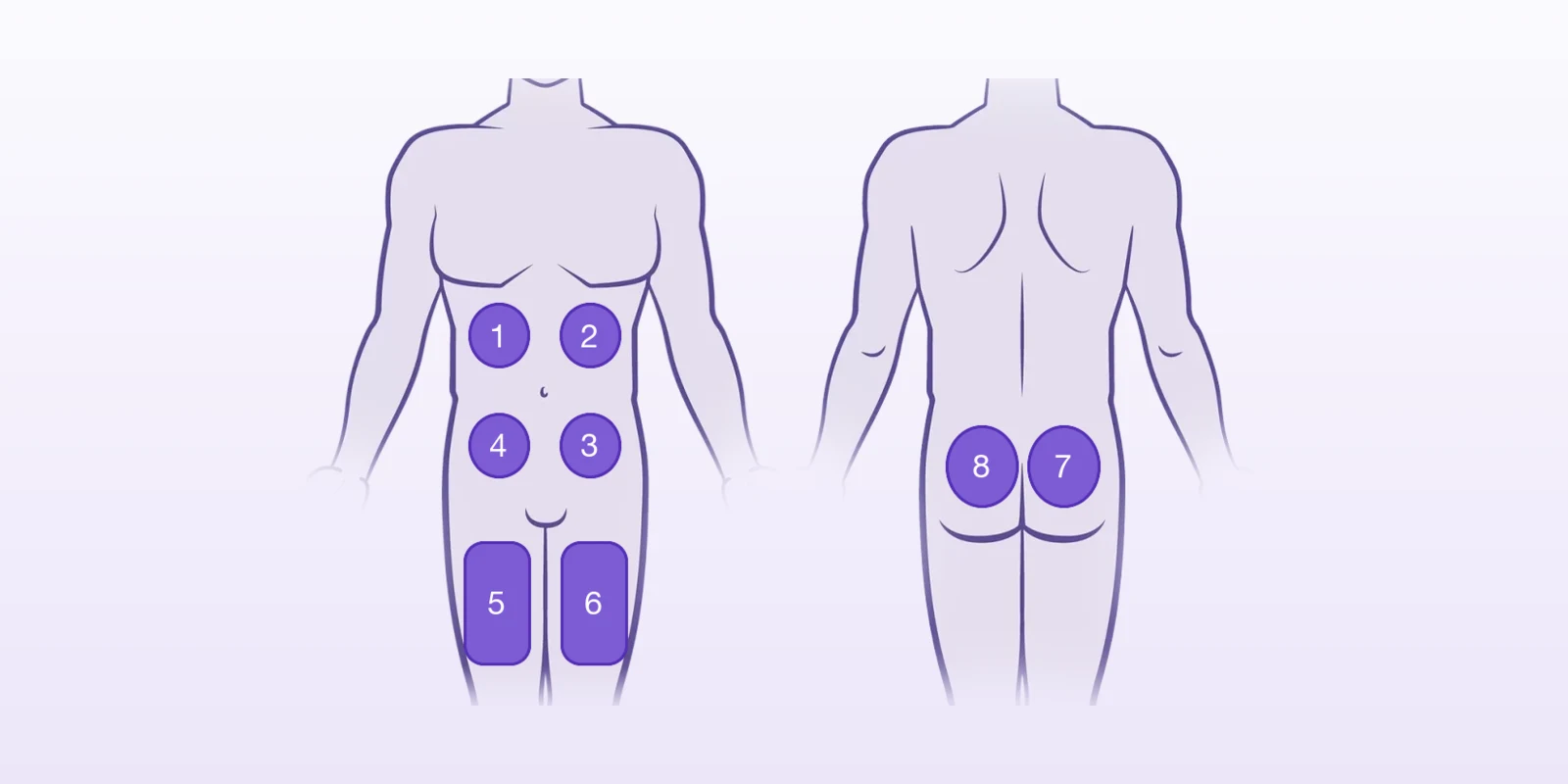
Why Rotate Injection Sites? Plus a SubQ Injection Site Rotation Chart
November 11, 2026
10 min read
Monica Hodgson
injection-sites
peptide-therapy
peptide-tracking
What happens when you inject in the same spot over and over, how injection site rotation prevents it, and a simple 8-spot subcutaneous rotation chart you can copy or build for your own schedule.
If you inject regularly, you've probably been told to "rotate your sites." It's one of those instructions that sounds optional. Your favorite spot doesn't hurt, it's easy to reach, and nothing bad seems to happen when you use it again.
The problem is that the damage builds slowly, under the skin, where you can't see it at first. By the time you can feel it, it may already be changing how your medication works.
This guide explains why rotating injection sites matters, what can happen when you don't, and how to set up a rotation you'll actually stick to. There's a sample subcutaneous injection site rotation chart below, and a free tool that builds one for your own schedule.
What Happens When You Use the Same Spot
Every injection is a small injury. The needle passes through skin, the medication pools in the tissue, and your body repairs the area afterward. Given time, that repair is complete. Without time, the repairs start to stack up.
Lipohypertrophy
The most common result is lipohypertrophy: a thickened, rubbery or lumpy patch of fatty tissue under the skin. It usually doesn't hurt, which is part of the problem. Many people keep injecting into these patches because they're less sensitive than healthy skin.
It's very common in people who inject often. In a 2013 study of about 430 people who injected insulin, published in Diabetes & Metabolism, close to two thirds had lipohypertrophy. Not rotating correctly and reusing needles were among the biggest risk factors.
Lipoatrophy
Less often, the fat under the skin breaks down instead of building up, leaving a dent or hollow. It's much rarer than lipohypertrophy, but it's another sign that an area needs a long rest.
Bruising, soreness and scar tissue
Even without lumps, using the same spot again and again keeps it bruised and sore. Over time, small amounts of scar tissue can form, and the skin can become harder to pierce.
Why It Matters for Absorption
Here's the part that surprises people. Lumpy, scarred tissue doesn't absorb medication the same way healthy tissue does.
Insulin is the best-studied example. Research has shown that insulin injected into areas of lipohypertrophy is absorbed less predictably, which can make blood sugar harder to control. The same principle applies to other medications given under the skin: the tissue you inject into is part of how the medication gets into your body.
There's a flip side worth knowing. If you've been injecting into a lump and then switch to healthy skin, your medication may suddenly be absorbed better than you're used to. With some medications that matters a lot, so tell your provider before you make the switch.
How to Rotate Injection Sites
Rotation happens at two levels, and you need both.
Within an area. Each new shot should land about an inch (2.5 cm) away from the last one in that area. If you use your abdomen, you might work in a circle around your belly button, keeping at least 2 inches from it.
Between areas. Move between your abdomen, thighs, arms and glutes in a set order, so every area gets a break. Our guide to subcutaneous injection sites shows where each area is and what to avoid.
The key word is order. Rotating randomly sounds fine, but in practice people drift back to their favorite one or two spots. A fixed pattern solves that, because the next spot is always decided before you pick up the needle.
Sample SubQ Injection Site Rotation Chart
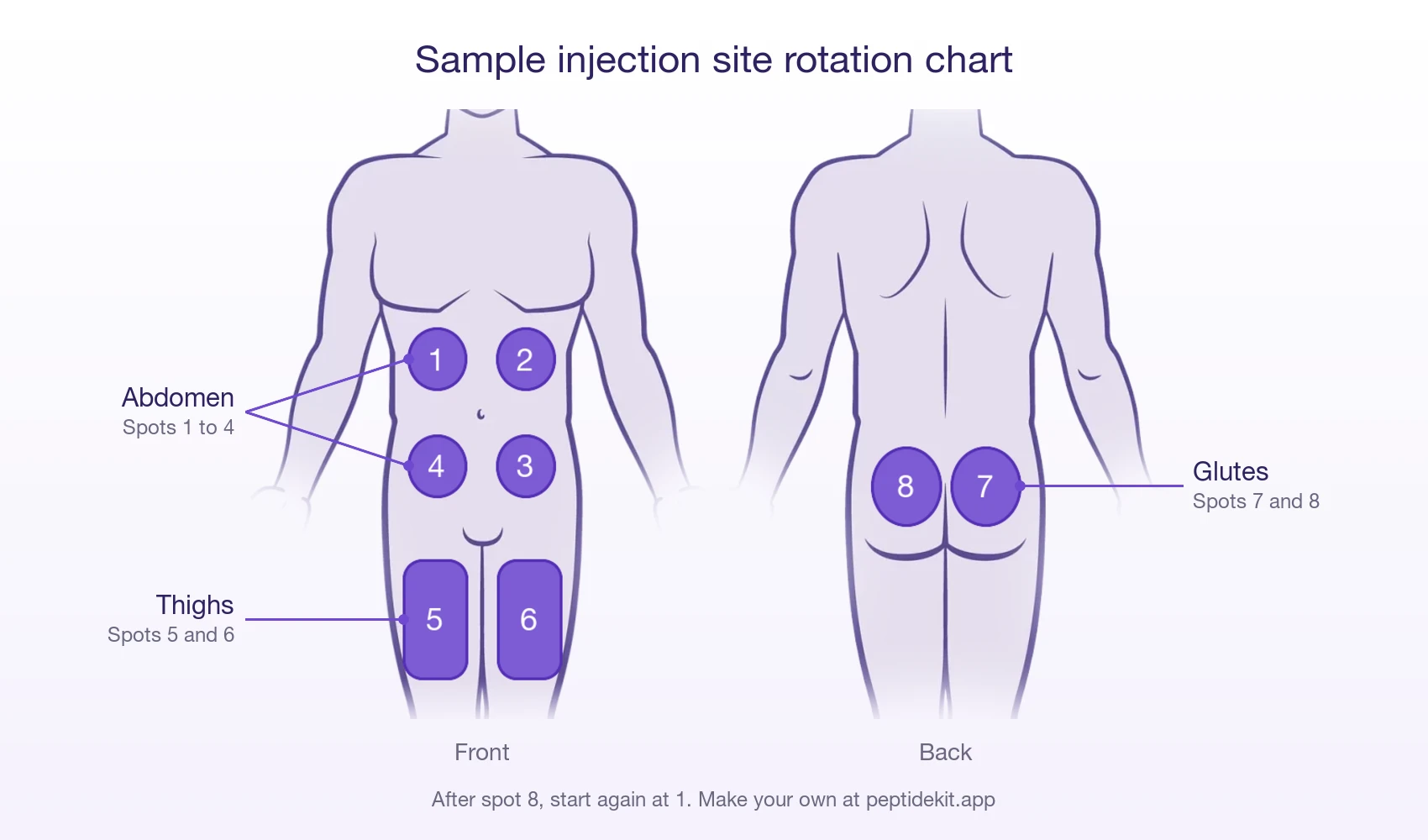
Here's a simple eight-spot rotation that works for many people who inject subcutaneously:
| Spot | Site |
|---|---|
| 1 | Abdomen, upper right |
| 2 | Abdomen, upper left |
| 3 | Abdomen, lower left |
| 4 | Abdomen, lower right |
| 5 | Right thigh |
| 6 | Left thigh |
| 7 | Right glute |
| 8 | Left glute |
Eight spots spread the work out more than you might expect. Here's how long each spot rests before you come back to it:
| How often you inject | Back at the same spot after |
|---|---|
| Every day | 8 days |
| Every other day | 16 days |
| Twice a week | About 4 weeks |
| Once a week | 8 weeks |
Optimize Your Peptide Therapy Journey
Take control of your peptide therapy with PeptideKit - the comprehensive app designed to help you track, monitor, and optimize your treatment:
- Add peptide therapy protocols with custom schedules that work for you
- Easy dose logging with customizable reminder notifications
- Body change tracking to monitor your transformation
- Progress visualization with charts and trend analysis
Download PeptideKit App
Scan with your iPhone camera
to download PeptideKit
Make Your Own Rotation Chart
Our free injection site rotation chart does the planning for you. Tap the spots you use on a front and back body map, pick your schedule, and it numbers the spots in order and lays out which spot goes with which date. You can print it or save it as a PDF and stick it wherever you keep your supplies.
If you haven't settled on a schedule yet, the peptide schedule planner maps out your shot days first, including on and off cycles.
Keeping Track of Your Last Site
A rotation chart only works if you know where you are in it. That's the hard part. With daily shots you might remember yesterday's spot. With weekly shots, almost nobody remembers where last Tuesday's went.
Some easy ways to keep track:
The method doesn't matter much. The habit does: write the site down every single time, right after the shot.
Does Rotation Matter With Weekly Shots?
It's easy to assume rotation is only for people who inject every day. With weekly shots, each spot naturally gets more time off.
But a favorite spot used once a week for a year still adds up to 52 shots in one place. Rotation matters just as much, and because weekly shots are so far apart, remembering where the last one went is actually harder. That's where a written chart earns its keep.
Common Rotation Mistakes
Most people who run into skin problems were rotating in some way. These are the usual gaps.
Only rotating inside one area. Moving around your abdomen is better than nothing, but if your abdomen is all you ever use, it never gets a real rest. Bring in your thighs, and your glutes or arms if you can reach them or have help.
Spots that are too close together. Moving half an inch "to the left" each time can keep you in the same small patch for weeks. Aim for about an inch between shots and use the whole area.
Drifting back to the comfortable spot. Areas with lipohypertrophy often hurt less, which is exactly why people keep going back to them. If one spot feels numb compared with the skin around it, that's a reason to skip it.
Losing your place. Missed shots, travel and switching to a new vial are the moments people lose track. Writing the site down after every shot means you can always pick up where you left off.
Signs It's Time to Rest a Site
Check your injection areas every week or so, by looking and by feeling with your fingertips. Stop using a spot, and mention it to your provider, if you notice:
Lipohypertrophy can take weeks or months to settle once you stop using an area. Your provider can tell you when it's fine to return to it.
Other Habits That Protect Your Skin
Rotation does the heavy lifting, but a few other habits help:
Frequently Asked Questions
Why do you need to rotate injection sites?
Injecting in the same spot over and over can cause lumps of fatty tissue (lipohypertrophy), dents, bruising and scar tissue. Medication injected into damaged tissue may be absorbed less predictably, so rotating keeps both your skin and your results more consistent.
How far apart should injection sites be?
Most guidance suggests about an inch (2.5 cm) between shots within the same area. In the abdomen, stay at least 2 inches away from your belly button as well.
What happens if you don't rotate injection sites?
The most common result is lipohypertrophy, a rubbery or lumpy area under the skin. It's often painless, so people keep using it, but it can change how medication is absorbed. Bruising, soreness and scarring are also more likely.
How do I make an injection site rotation chart?
Pick the areas you use, split them into numbered spots and decide a fixed order. Our free injection site rotation chart tool does this from a body map and matches each spot to a date on your schedule.
How long should I wait before using the same spot again?
It depends on how often you inject and how many spots you rotate through. With eight spots and daily shots, each spot gets a week off. Your provider can advise on your situation, especially if you've noticed lumps.
Should I stop injecting into a lump?
Yes. Stop using that spot and let your healthcare provider check it. If you move from lumpy tissue to healthy skin, your medication may be absorbed differently, so talk to your provider before making the change.
The Bottom Line
Rotating injection sites isn't a formality. Repeated shots in one spot can lead to lumps, dents and scar tissue, and damaged tissue can change how your medication is absorbed.
Rotate within each area by about an inch, move between areas in a fixed order, and write down every site. A rotation chart and a simple log are all it takes to stop guessing.
Always consult with qualified healthcare professionals before starting any peptide therapy protocol. This information is for educational purposes only and does not constitute medical advice.
Related Articles
How to Remember a Weekly Injection (and Know If You Already Did It)
Weekly shots are easy to forget because they never turn into a daily habit. Simple ways to remember your injection day, check whether you've already done it, and keep your place when life gets busy.
Lump After an Injection: Is a Bump Under the Skin Normal?
Why a small lump can appear after a subcutaneous injection, how long it usually lasts, what helps it settle, and the signs that mean you should call your provider.